Chapter 19F: Option 4
Published July 28, 2026
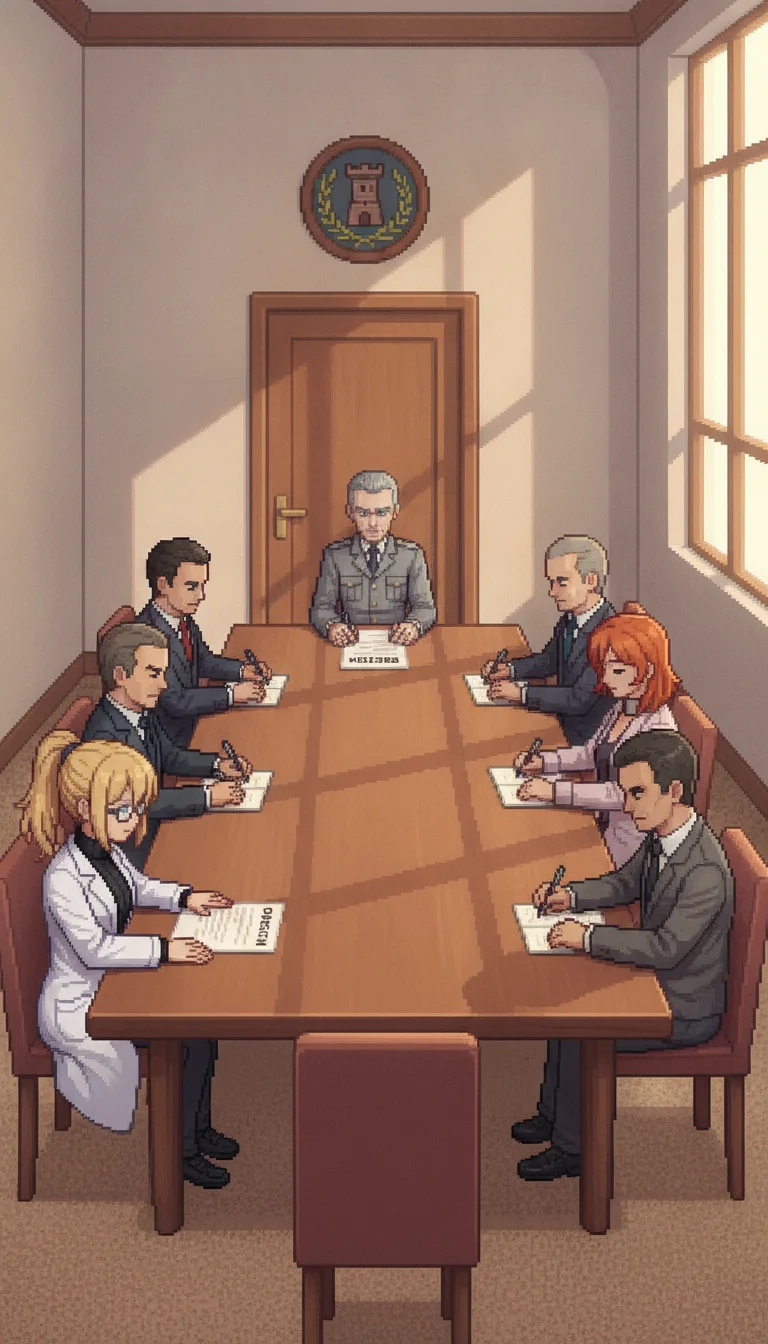
Erika, before
The committee met on the third floor of a building I had been in perhaps six times in three years, always for the same reason: a squat civic structure two streets back from the harbor administration block, built for permits and land registries and had absorbed the oversight function the way a filing cabinet absorbs whatever gets put in the wrong drawer often enough. I always took the same route to it, the coast road and then the second turning inland, and I had stopped noticing the walk sometime in the second year.
The room did not belong to the research program. It belonged to whoever had scheduled it that week: a long table built for a purpose more permanent than anyone who sat at it, light from a bank of windows facing a street I never had time to look at properly. A civic crest hung above the door, its paint fresher than the rest of the wall, the only thing in the room maintained on its own schedule rather than left to wear.
Commandant Reiss chaired from the head of the table, which was not a research position and had never been explained as one. By the second meeting I had filed the oddness of it and moved on, the way I filed most things that were not mine to correct. He was a compact man, iron-grey hair cut close enough that it read as maintenance rather than style, sleeves precise to the same crease each time I saw him. He did not raise his voice in either of the meetings I am able to recall clearly. He did not need to. Authority sat on him the way a well-fitted coat sits on someone who has stopped noticing they are wearing it, not performed, simply worn long enough to have become the shape of the man underneath.
Six other people sat along the table that session, civilian titles I had learned and mostly forgotten because none of them spoke without looking at him first. Two took notes by hand, in the neat, disengaged script of people transcribing rather than thinking. It did not change what happened to my objection when it reached the table.
Formal objection, filed this session: Accelerated field deployment timeline, combat AI framework certification. Submitting researcher: Dr. E.
I had written it the way I wrote everything meant to survive contact with a room like this: numbers first, feeling nowhere. The certification protocols for the three combat frameworks required staged field trials at intervals I had specified for reasons that were, at the time, entirely defensible. The revised schedule compressed those intervals by more than half. I said as much, plainly, the way I said most things in that room, and I watched Reiss listen to the entire objection without once glancing at the paper in front of him, because he already knew what it said before I opened my mouth.
"Your concern is noted, Doctor."
He used the title the way he used most words in that room, correctly, and to close something rather than open it.
"The certification protocols remain your responsibility to execute to the standard you consider adequate. The schedule they execute within is not a research decision."
"The schedule determines whether the standard is achievable."
"Then achieve it faster." He said it without cruelty. "The Empire's advance elements were logged forty kilometers closer to our waters this month than last. I do not have the luxury of asking them to wait for a committee's preferred interval, and neither, I am afraid, do you."
Nobody at the table disagreed with him. Nobody at the table had disagreed with him in any of the sessions I had sat through. One of the note-takers glanced up at me for a fraction of a second after he said it, not unkindly, the particular look of someone who has watched the same exchange happen to other people before me and will watch it happen to others after. I made a note of the response in the same clinical hand I had used for the objection itself, filed it, and did not raise the point again that day. There was no version of raising it again that produced a different answer.
It was somewhere in the gap after that, while the next item was being read into the record, that I watched Reiss take a pencil from an inside pocket and write something in the margin of his own copy of the agenda. Not the fountain pen he used for anything meant to be read by someone else. A pencil, a hand faster and smaller than the signature I had watched him apply to a dozen authorizations, three lines, done in the time it took the man beside him to finish a sentence. He turned the page before I could have read it even if I had been trying to. It registered the way a colleague's private habit registers, worth noting and not worth asking about, and I let it go.
The item that mattered came near the end, filed under a heading bland enough that I did not flag it as anything at the time: Civil contingency planning, northern and coastal sectors: status update.
"Population safety is being addressed in parallel with the program," Reiss said, to the room generally, the way a man reads a line he has read in six other meetings and expects to read in six more. "Contingency planning is proceeding on its own track and does not require research committee input at this stage."
One of the note-takers paused with her pen lifted off the page, the first break in the neat transcribing rhythm I had watched all session, and did not write anything down until Reiss had finished his answer. I asked what "proceeding on its own track" meant in practical terms, for the people living closest to the installation.
"Precautionary arrangements are in place." Flat, unhurried, the same register he had used for the certification schedule and would use for the next item on the agenda after this one. "Should the timeline require it, the relevant sectors can be moved with the notice we have already scheduled to give them. That planning sits with the civil authority, not with your program, and it is proceeding as it should."
I remember thinking that this was a reasonable division of labor. A research committee did not run evacuations. A military commandant with a civil title did. I nodded, made the note I made for items that were not mine to carry, and let the meeting move to the next line on the agenda.
Nobody in that room said the word evacuation. Nobody needed to.
The meeting closed the way it always closed, Reiss thanking the room in the same even register he had used for every item on it, difficult and administrative given equal weight. I gathered my papers. The pencil-margined agenda was already back in his inside pocket.
Outside, the corridor was cold in the particular institutional way that had nothing to do with the season. I stood at the window at the end of it a moment before going down: the street below ran toward the harbor, ordinary foot traffic, a delivery cart, two women talking outside a shuttered shopfront, a tram passing half empty. Twenty thousand people, going about a Tuesday.
I turned back once, my hand already on the corridor door. I could have gone back into that room and asked Reiss directly what "the notice we have already scheduled" meant in practice: what day it counted from, who held the authority to call it, whether the number of hours had been fixed yet or was still open to revision. I did not go back in. There was a testing protocol waiting on my desk that was mine to solve, and I had learned, by then, exactly which problems were worth the hour it would cost me to keep turning them over, and which were not. I filed this one under the second kind, and I went down the stairs and out along the coast road instead of waiting on the shuttle.
The tide was out, the light flat and grey the way it stayed most of that month, and the coast road smelled of salt and diesel from the ferry idling at the pier. A fisherman was working a line of nets on the rocks below the seawall, unhurried, the same man I had passed on that stretch of road more mornings than I could count and never once spoken to. I watched him until the road bent inland and the rocks went out of sight, and then I went back to the part of the building where the work was actually mine.
Previous Chapter: The City | Next Chapter: The Plaque
Panzer Island is also a strategy game available on Steam, Google Play, and itch.io. Chapter 1 of the game is free. If you want to experience the story differently, or continue past where the novel is currently, visit the Panzer Island homepage.
If you're enjoying the story, consider following or leaving a rating on Royal Road. It helps new readers find the series.