Chapter 36: Don't Move Too Fast
Published August 28, 2026
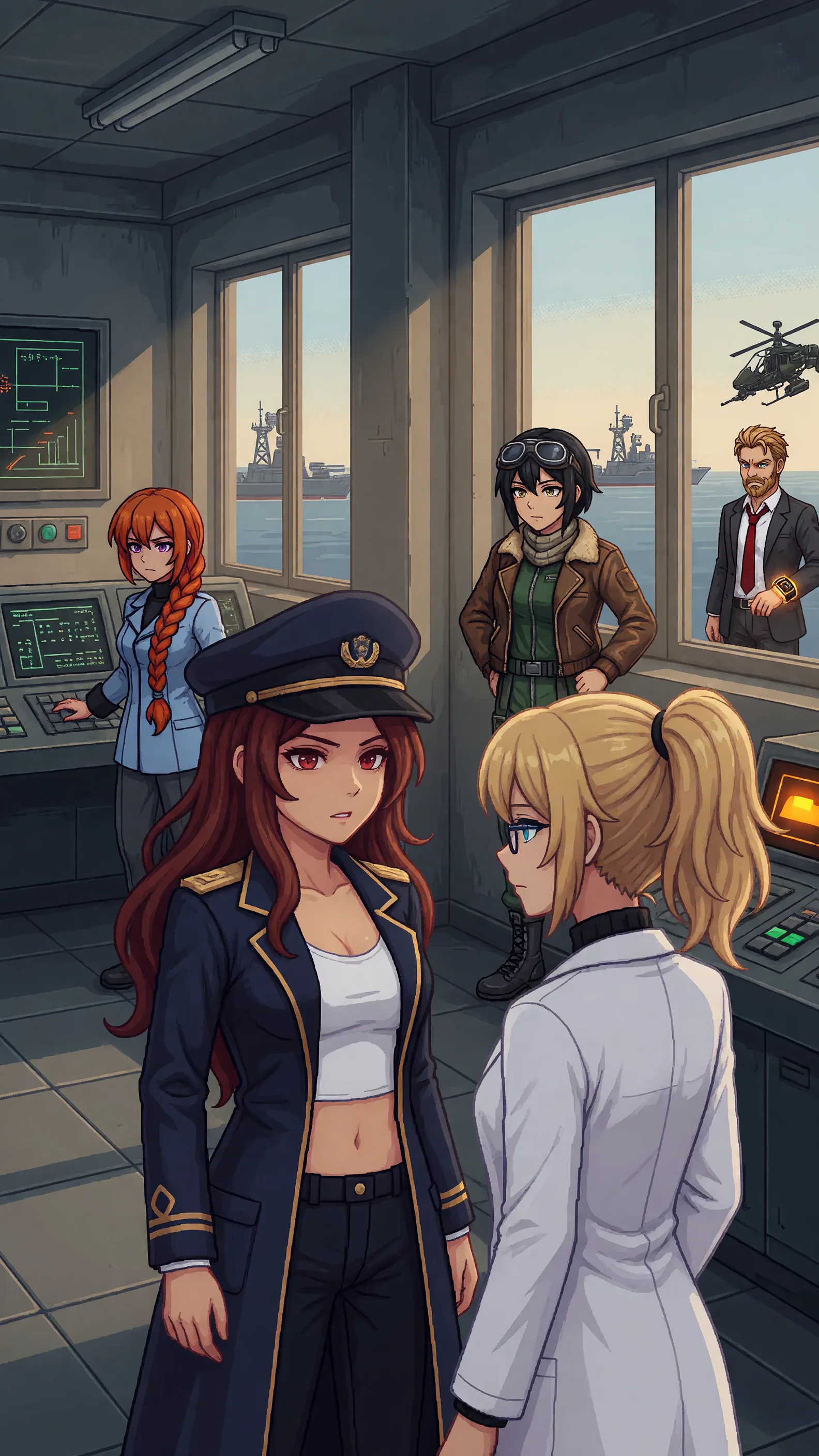
We held the operations room through what was left of that day and the night that came after it, in shifts nobody assigned out loud. Katyusha took the watch the machines needed. Nadeshiko took the watch I needed, waking me twice to put something in my hands and eat it, and once, near what her instruments called morning, to tell me the fleet had not moved. Maria did not stand a watch so much as occupy the room the way she occupies every room she is in, present enough that leaving it would have felt like abandoning a post nobody had posted her to. Wilhelm slept somewhere I did not track. Between the four of them, two more sectors of Oracle's outer deployment went quiet without my really noticing it had happened; there had been nowhere better to put the attention than into finishing it.
I slept in pieces on the floor with my coat under my head, which is not a sentence I would have written about myself two weeks ago and did not have the energy to be surprised by now. Somewhere in the second stretch of dark, the console's amber indicator was the only warm thing in a room built out of grey surfaces and colder light, and I remember checking on it the way you check a pilot light, confirming with each look that the house was still a house.
By the time the light through the tall windows had gone from grey to something with gold in it, the number on Katyusha's panel had moved further than a night should have accounted for. Nobody remarked on the arithmetic. I did not ask her to explain it to me, and she did not offer to.
The room itself had not changed since the morning we first walked into it: the same secondary consoles lining the walls, the same reflecting pool visible through the far window if you knew to look past the fleet for it, the Oracle indicator holding its low amber in the same corner it had held it in every hour we had spent in this building. I had stopped noticing it, the ordinary blindness of a clock in a room you live in. That, more than anything, told me how long we had actually been here.
Wilhelm was the first to move with any intention. He came off the console, not abruptly, more like a man confirming a task was already finished, and crossed to the windows on the far wall. He did not sit. He stood with his hands loose at his sides and looked out at the fleet, which had rearranged itself overnight into a shape I could not read and did not try to. His watch caught the window light and held it, a small steady glow at his wrist, the room's only warm color besides the console. He had stepped back from the controls. He had not stepped back from the room. There is a difference, and I was learning to notice when he meant it.
Nobody filled the space he left at the console. I understood, a beat late, that he had made it on purpose. Katyusha stayed at her panel, near enough to the door to still be reading it. Nadeshiko had drifted to the window opposite Wilhelm's, tracking the same fleet from a different angle. Maria had found the wall nearest me. She rearranges a room by walking through it, as a matter of course. This time she hadn't.
Katyusha turned from her panel first, the orange braid catching the window light. She does not hedge before she speaks, the ordinary human tell of someone still deciding whether to say a thing; she has already decided by the time she turns.
"I have been attempting to construct an optimal outcome matrix since we entered this building," she said. "I cannot. The variables include my own wellbeing under each option, which is relevant but not the only variable, and when I weight it correctly the matrix does not resolve to a single recommendation."
She let that stand for exactly as long as it took to be true and no longer.
"I find that I do not want to tell you what to decide. I am aware that I have an interest in the outcome. I have been trying to set that interest aside. I have not fully succeeded." Her hands did not move from the edge of the panel, exactly where they had been through the whole sentence. "I trust your analysis. I am telling you that because it is accurate. You should have that information."
I did not thank her for it. "Noted" would have been the old shape of my answer. I gave her something closer to the truth instead: "I know you have. I have been watching you not do it."
Her eyes stayed on mine, steady, until I was the one who broke it.
Nadeshiko had been at the window the whole time, close enough to Wilhelm that I had assumed, wrongly, that she was keeping some kind of watch on him. She turned when Katyusha finished, and I saw that she had not been watching Wilhelm at all. She had been watching the fleet the way she watches everything that might move.
"I spent the whole time we were in the northern sector asking why the people didn't fight," she said, "and then I watched what protection looks like when all it can do is log a departure and keep logging." The second half of that sentence came out exactly as hard as the first. "I don't want to fight the fleet. That's not because I can't. It's because I think that's the wrong fight."
She crossed the distance to where I was standing, closing it faster than the question needed.
"Whatever you decide. Does it mean they can come home? The people from the north. From the settlements."
She was not asking about strangers, and I understood, without her spelling it out, that this was the same list folded into a different shape of question. Not how many, not anymore, but what for.
"I know you can't promise. I'm asking if that's the direction."
"I don't know yet," I told her, and meant it as fully as I have ever meant three words in this building. "I know it's the question I'm trying to answer with whichever one I pick."
She nodded, once, and let that be enough.
Katyusha had asked without asking for permission to be believed. Nadeshiko had asked for a direction and accepted not having one yet. I stood in the middle of both of those and said nothing, because there was nothing I could have added that would not have been smaller than what each of them had just handed me.
Maria had not moved from where she was standing. When she finally crossed to me, she had already dropped everything on the way: the grin, the lazy roll in her shoulders, the half-second delay she always leaves before a line lands so the room has time to brace for the joke. None of that made the crossing with her. What arrived at the console was just her, unattended, and it turned out to be quieter than the performance had ever let on. The hat stayed at its usual tilt. Everything under it had changed.
"Doc," she said.
She let a pause sit under the word longer than she has ever let one sit under it before. I had heard her say it dozens of times since the tideline, and every one of those times had been a door held open. This one was a door already through.
"There's a word you used to say. I've been listening for it this whole time, waiting to hear if it sounds the same coming out of you now." She shook her head, small. "It doesn't. You're different."
I reached for whatever memory she was standing next to, the specific occasion, the room it might have happened in, and found the same nothing I have found every other time I have reached for something that far back. The reach opened and closed without landing on anything, and I let it close rather than force it.
"You asked me once what I was holding," Maria said. "I told you on the other side of the gate." Her shoulders came down half an inch, the specific give of a weight set down rather than shifted. "This is the other side."
"I remember you from before," she said. "Not clearly. Just enough to know you were afraid, and you moved too fast because of it."
I did not think "not clearly" meant the memory had lost its edges. Maria does not lose things. I thought it meant she had decided which edges I got to have.
"I know," I said. It came out steadier than I expected it to. I did not know the specific fear she was naming. I knew the shape of it, the way you know a scar is yours without remembering the cut.
"Are you afraid now?"
"Yes."
"Good," Maria said. "Afraid is honest."
She reached up and resettled the hat at exactly the angle it had never actually left. Not a performance, just the way she carries herself.
"Don't move too fast this time, Doc." A short breath, almost a laugh, not quite one. "That's all I've got."
The number on Katyusha's panel changed before anyone else in the room found something to say. "Twenty-seven hours remaining."
"That is more than most people have at this point," Wilhelm said, from the window, not turning around.
I could not tell whether it was comfort or a measurement. I did not ask him to clarify which. I am not certain he knew either.
Nobody moved to end the quiet he put back into the room after that. Katyusha logged the number and did not repeat it. Nadeshiko went back to the window, watching the same fleet she had been watching all night, as though a different answer might arrive from it if she gave it enough attention. Maria stayed where she had landed, close enough that I could still feel the fact of her having crossed the room, and did not go looking for the hat's next joke.
When we did move, a few minutes later, it was toward the door on the far side, the one none of us had used yet, the corridor beyond it darker than the room we were leaving and colder, in the specific way of air that has not had four people breathing in it for a while. Wilhelm came last, as he had come last into every room since the reset gave him a room to be last into, and did not offer to go first this time either.
Panzer Island is also a strategy game available on Steam, Google Play, and itch.io. Chapter 1 of the game is free. If you want to experience the story differently, or continue past where the novel is currently, visit the Panzer Island homepage.
If you're enjoying the story, consider following or leaving a rating on Royal Road. It helps new readers find the series.