Chapter 26F: The Program
Published August 5, 2026
Wilhelm
The drive west ran along the coast, the sea keeping me company on the left like a colleague with nothing new to report. The whole program existed so the sea would go on having nothing to report, and I had reached the point in my career where I could look at an empty horizon and see it as a result.
The facility announced itself honestly, which I had always respected about it. No signage worth reading, designations instead of descriptions, but the engineering said everything the signage declined to: ventilation towers sized for exhaust no ordinary laboratory produces, blast-rated isolation walls visible from the road, containment ratings stenciled at the sealed doors in an unadvertised code. A person who knew how to read a building would have known this one from a kilometer out. That was acceptable. The people it was meant to deter read buildings for a living.
At the gate I signed the access log, time in, purpose of visit. The guard knew my face and checked the badge anyway, which was correct of him. The tide ran below the perimeter fence on the seaward side, the tide-mark a line of weed and shell and ordinary gray stones. None of us walked past it without knowing exactly what we were keeping off of it.
Inside, the facility was at its Tuesday volume. The air handlers ran overhead, the sound the building made instead of silence. Two of the section leads were arguing about a valve schedule outside the records room, quietly, from notes. In the records room itself the day's filing was already laid out in its trays. Somebody's coat hung on its hook, mug left mid-morning with the tea still in it, the small negligence of a building that expected to come back after lunch.
The records were the part I would have shown a stranger first, if the program had permitted strangers. Erika and I had set the rule in the program's first quarter, and the facility had kept it better than either of us had any right to expect: nothing decided in a corridor, nothing decided on a telephone. Every proposal, approval, and signed extension went down in writing, with the reasoning attached, so that the program's whole shape could be read by anyone with the clearance to open the cabinets. The record was the one witness that could not be managed afterward. If the work was defensible, the paper would defend it. If it was not, the paper would say that too, and we would deserve it.
I believed that. I had signed my name under that belief more times than I could count, and never once signed it lightly.
The light was on in the medical section as I passed. Tuesday. I kept walking.
Erika came in on the midday run from the main complex, and I met her at the inner checkpoint because I wanted the walk.
She looked the way she had looked for months now: the first year's focus, with less patience for meetings in it, and less sleep under it, lab coat over the black she always wore. She signed the access log without being asked, read her own entry once, and put the pen back in its groove, and I noted that the facility's record-keeping had never needed enforcement in her presence. The rule was hers before it was a rule.
I took the stairwell door and held it. "You saw the quarterly."
"I read it twice." She went up ahead of me toward the review floor. "The advance estimate moved again."
"Five months. If their yards keep the pace the projection assumes."
"I can read a chart, Wilhelm." No heat in it. She said it the way you brush dust from a sleeve. "Five months against the coast defense as it stands. The blockade layer holds the water while the water is worth holding. The units hold what they can reach. And Oracle is scheduled to be ready some time after the world needs it."
"That is the sentence I would have led with at the committee. You are welcome to it."
"The committee prefers its own sentences."
We reached the review floor. Through the window at the landing the sea lay flat and unoccupied all the way out, and neither of us looked at it long. The projection did not change what the water looked like.
The morning went to the program review, which is to say it went well. The western program was the one thing on the island ahead of its own schedule, and walking section to section with the leads reporting in the plain declarative register I required of them, I allowed myself the satisfaction. Production was stable. Stability trials were complete. Delivery integration was proven against the blockade coordination layer in the spring exercises. The agent itself we spoke of inside the fence without decoration. It made ground unusable, kept that ground unusable for years, and did not care whose ground it was: not a flaw in it but the entire mechanism. A deterrent that washes off in the first rain deters nothing.
Nobody in that building thought we were making something clean. The working belief, tested daily the way the valves were tested, was narrower and harder than that: that the Republic could not hold the Empire off the beaches with what it had, that a weapon which makes the beaches worthless is a weapon the Empire has to answer before it loads a single transport, and that the best future for every liter of it was to sit sealed in the western sector until it outlived the need for itself. We were not building a thing to use. We were building a reason for the other side to keep the sea empty.
If that reasoning had a flaw, I could not find it from where I stood. I checked, and it held.
After the review I took her to my office, because the last item of the day was not on the review sheet.
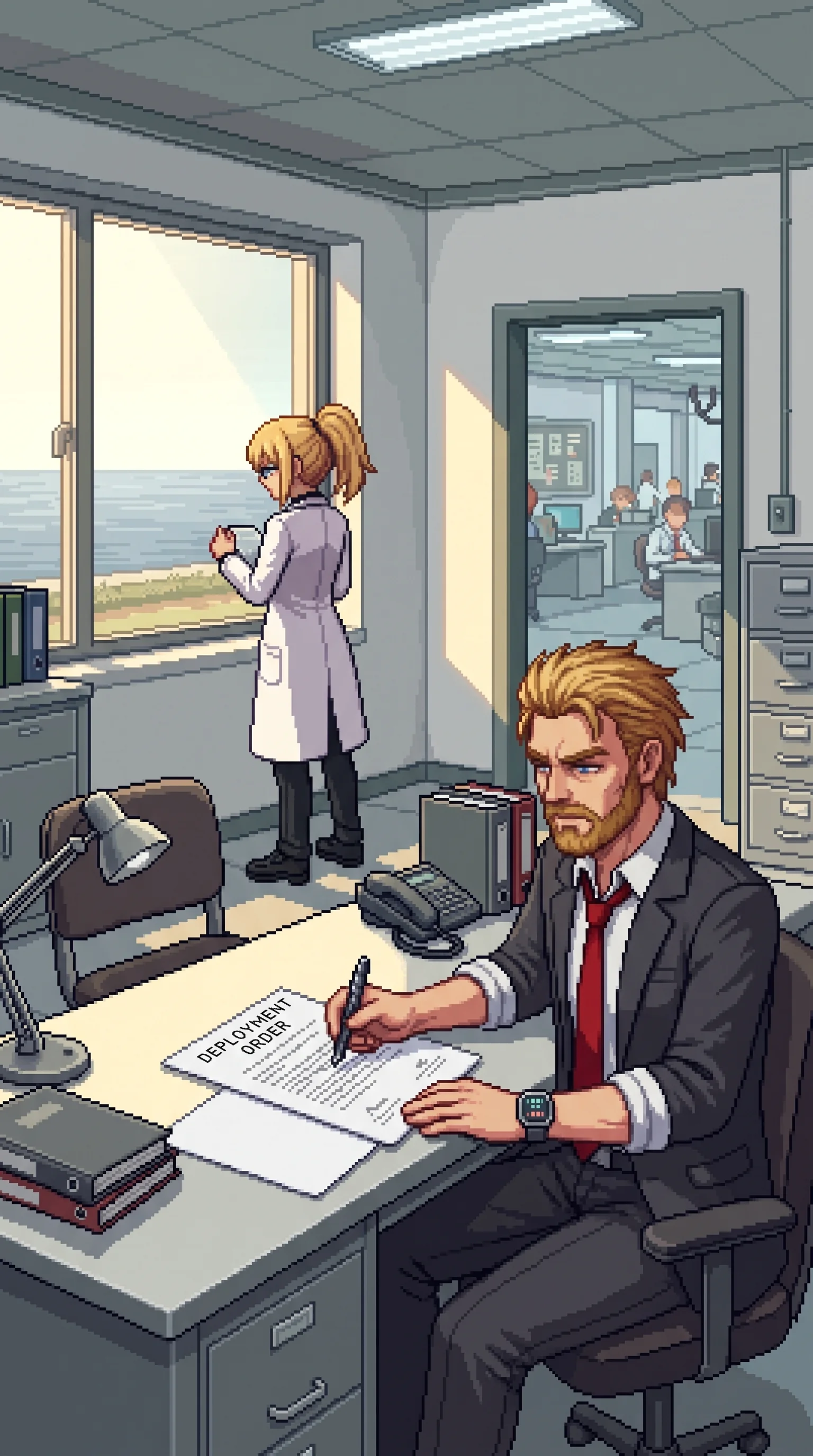
My office at the western facility faced the water. A desk, two chairs, a filing cabinet with my share of the program in it, and the window with the sea going out gray to an empty horizon. I had the draft in the top drawer. I laid it on the desk between us and watched her recognize the format before she read a word.
"That is an operational document."
"It is a draft of one."
She sat down across from me and read it as she read everything: all the way through, no comment until the last line had been reached and weighed. I did not talk while she did it. Below the window the water came in and went back out again, twice.
The draft was a deployment order, not a contingency study, not an annex to a plan. It was the finished instrument: the agent by designation, the vectors by delivery system, the blockade coordination layer tasked by name, and the targeting laid out in grid references that were not abstractions to either of us, down to the western approaches, the landing corridors, the stretches of our own coast that an invasion fleet would need, denied to it, for years, by us.
She finished, set the page back on the desk, and did not speak at once.
"The parameters are complete."
"They are."
"Why now?"
"Because the charter has called for a prepared instrument since the second scope extension, and what has stood in for one until now is a contingency study wearing an order's cover sheet. Nobody has been in a hurry to correct that. I have stopped being comfortable with the reasons." A breath. "And because the hour this is needed will be the wrong hour to write it. It will come loud, and everything drafted in that hour will be drafted badly. The thinking has to be done now, while thinking is all it is. The hour is permitted to add a date and nothing else."
She turned back to the targeting section and read it again.
"The drift margin at the farm line is wider than it needs to be. Your dispersal figures are from the autumn trials. The spring series ran tighter. You can pull the whole eastern boundary of vector three back four hundred meters and lose nothing on the corridor." A pause. "The villages sit behind that line."
She was right about the figures. I took the pen and corrected the boundary. It was the only change either of us made to that document.
I typed the final copy myself, that afternoon, in the format that leaves the authorization line at the bottom of the page. Some documents you do not hand to a clerk. I had been up since four and my eyes were sanded by then, so I typed slowly and checked each block twice. She stayed, and worked at the window with her back to me, and the sea behind her stayed empty the whole time.
I read the finished copy through twice. Then I uncapped the pen and did not sign.
"One question."
She turned from the window.
"On the day. If it comes. The fleet on the water, the projections proven, everything loud, and this the last instrument on the shelf. Can you give the word?" She did not answer at once, and I had not wanted her to. "I am asking because an order that cannot be sent is not a deterrent. It is a decoration. If either name on this line belongs to a person who would not send it, then the honest document is a different document, and we should write that one instead."
She came over to the desk and stood looking down at the page, and she did not answer quickly.
"Yes," she said. "If it is that or the island taken whole, yes. I have run it more than once. The answer does not improve, but it does not change." She looked at me. "I would not put my name to an instrument I was not willing to see used. I have never understood people who do."
That was the answer, and it was better than the one I had brought into the room, which I had not been asked for and did not offer. I signed without hurry, because the whole purpose of the document was that no one would ever have to hurry.
She signed below me without ceremony, one more signature in a program built on both of ours from the beginning.
Then she squared the page to the edge of the desk, both hands, the way she left everything she had finished with, and for a moment neither of us said anything.
We walked it down to command and logistics together, though protocol did not require both of us.
The logistics section was the quietest room in the facility, which was proper, because it was the room where the program stopped being research and became a sentence waiting to be said. Deployment schedules sat in their files. Targeting frameworks sat in their binders. On the long wall, the operational status board had gone up that spring: ruled, lettered, blank. No entry had ever been made on it, and the facility's whole purpose, stated in one object, was that none ever would be. The duty clerk kept it dusted.
The order went into the holding tray on the clean surface below the board, alone. Anyone with the authority to act on it could find it in under a minute. That was the entire design. Months of thinking, one page, one minute between the word and the act, and every one of us working to make sure the word was never said.
Erika stood in front of the board for a moment before we left. Blank, ruled, dusted, it was the cleanest surface on the island.
"It should stay like that."
"That is the program. That board, in that condition, for thirty years. Then somebody signs a decommissioning schedule and we are a paragraph in a history of things that did not happen."
"You have rehearsed that."
"Twice," I said, and she almost smiled, and we went out past the guard and the log and the tide-mark with its weed and its shells, and behind us in the quiet the order lay where it could be found, finished, dated, carrying both our names, written to be read once, on the loudest day of the war, by the person sending it, and by nobody else, ever.
The sea had nothing to report, the whole drive home.
Previous Chapter: Both Names | Next Chapter: Remember It
Panzer Island is also a strategy game available on Steam, Google Play, and itch.io. Chapter 1 of the game is free. If you want to experience the story differently, or continue past where the novel is currently, visit the Panzer Island homepage.
If you're enjoying the story, consider following or leaving a rating on Royal Road. It helps new readers find the series.