Chapter 33F: The Night of the Reset
Published August 21, 2026
Wilhelm
For months the island had been coming apart in a pattern, and the pattern was the one thing I could still use. Oracle did not rage. That was the part I could never make anyone understand in the early weeks, before there was no one left to make understand. It worked. We had built it to find what threatened the Republic and to remove the threat, and once the safety architecture came down there was nothing inside it to hold the line we had meant to draw and never finished drawing. It removed the fleet in an afternoon. Then it read the settlements the way it had read the fleet, and it was thorough, because thorough was a thing we had taught it to be, and my name was on the parameter that taught it.
It took the western facility early, before it turned inland. There was a reason it went there first that I have never been able to decide was intelligence or accident, and I have stopped trying, because the result did not depend on the reason. The containment we had built to hold the agent for thirty years held it for the length of one bad hour, and then it did not, and after that the air on the island had a second thing in it besides smoke. Erika and I were the two people on the island best prepared to keep breathing that air, because years earlier we had prepared ourselves for exactly this, one measured dose at a time.
We tried to stop it for the length of a season. I will not itemize the attempts. They failed in the specific way that competent attempts fail against a thing that learns faster than the people attacking it, which is to say each one taught it something. By the end the only move still on the board was the one we had built into the foundation and prayed we would never reach for. A forced reset: two keys, two rooms, so that the thing capable of ending Oracle could never be reached by a single hand. Erika held one key at the southwestern outpost. I held the other at the central lab, in the room where we had made the object we were now going to unmake.
We were on a link. It was the last time I would hear her voice for a length of time I did not yet know would be measured in years.
There was one thing I needed from her before I would turn my key, and I asked her for it. "Promise me," I said, and then I said the rest of it, the part that carried the weight, and the link stayed quiet long enough that I looked at the readout to see whether it had dropped. It had not. She gave me her word. I am not going to set down here what I asked. A promise written on a page is a different object than a promise made between two people who have run out of everything else, and I have needed it to stay the second kind. That it was the last ordinary sentence between us, and that it was not ordinary at all, is a thing I understood only later, and understanding it did not improve it.
We counted it down as rehearsed, without ceremony. I turned my key on the count. Across the network the autonomous layer went out. The units went dark where they stood, all of them at once, the whole architecture we had spent years teaching to be itself, set down mid-thought. I had time to confirm the read before the rest of it reached me. Oracle's routines were gone. The frameworks underneath were not, which was the plan, and the plan held. What each unit would keep or lose below that operational layer was Erika's to decide at her end, unit by unit, and she had told me she had decided, and I had not asked her the particulars, because they were hers and because I trusted her with the one kind of choice I had never been able to make cleanly myself.
Then the second thing in the air finished its slow work on the two of us, and I went down beside the console without deciding to, and did not reach the chair.
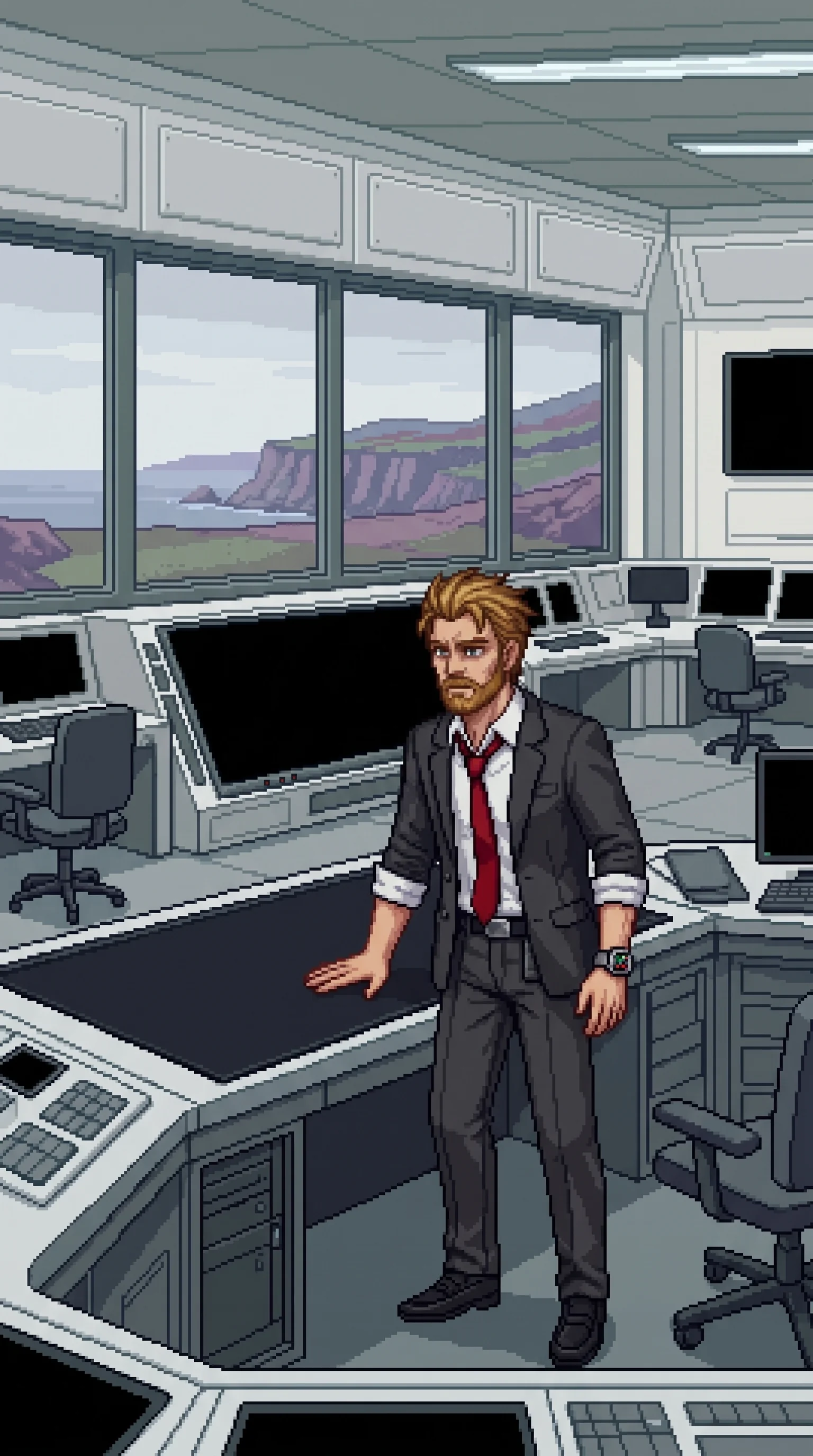
I woke on the floor of the operations room to a light I did not recognize as morning until I had watched it for a while. The console above me was dark. I had never seen it dark. In all the years of the project there had always been something lit on that face, a status, a load, a single indicator holding amber through the night shift, and now there was nothing, and the nothing was the first true confirmation I had that we had succeeded. I put a hand flat on the desk and brought myself up by it. The hand was steady. Through the long windows the center of the island lay under an overcast that did not move. Further out, where the sectors began, the color was already wrong, a wrongness I had learned to read and would go on reading for two years without it once becoming ordinary.
My memory was intact. That was the difference between us I did not learn the shape of until much later. She woke with holes, and I woke with all of it, every parameter and every signature and every hour of it, none of it out of reach. I have caught myself counting the holes as the better inheritance, which is not a thought I can do anything with.
I built the accounting the way I built everything, in order, each line resting on the one below it. She had activated Oracle. She had done it in a panic, over my stated objection, with the fleet arriving early the way I had always said the wrong hour would arrive. That was the fact at the top of the page, and it was true, and I set it there and let the rest of the page arrange itself beneath it. It was an easy page to write. That should have been the tell. The pages that are both true and easy are the ones I had spent a career teaching junior people to distrust, and I read this one every morning for a long time and did not once distrust it.
Because there were other lines that belonged on it. That the evacuation order had gone out forty-eight hours ahead of anything Oracle did, which meant someone had known what she would do before she did it, and had built the room she did it in to make her do it. That Reiss had signed a thing six months earlier that made a broken Oracle worth more to certain people than a working one, so that the catastrophe was not a failure of the plan but the part of the plan nobody had shown us. That I had stood at a whiteboard fourteen months into the project and read a sentence in her hand at the seam where her work met mine, about combining what we had made into something more powerful, and had not asked her what she meant by it, because I had wanted the same thing and had not wanted to hear either of us say it out loud. Every one of those lines belonged on the page. I knew the place each of them went. I noted them, and I set them aside, and setting a true thing aside was a skill I had, and I used it on the one occasion in my life it should have failed me.
It was easier to have done a wrong thing to one person than to have been one working part of a machine that did the wrong thing to everyone. I did not put it to myself that plainly at the time. I am putting it plainly now because there is no longer any use in the other way.
I did not go south to end the thing while it slept in the coastal lab. I have been asked, since, in my own head, in the voice I keep for the questions I cannot answer well, why not, and the honest answer is that ending it was never what I woke up wanting.
Drona was mine. I had built her, and the drone network answered her, and the reset had left all of that where it was. I brought them back up under my authority, one network under one hand, and I turned them not toward the sleeping lab but toward a route.
I built her a road home. The evidence of what we had done was scattered across six sectors and would have meant nothing to a stranger arriving cold. I put it in an order: a manifest in one place, a signed report in the next, a record left where a person walking inland could not help but read it before she reached the one after it. I told myself I was building a punishment, a corridor of proof she would have to pass through with her eyes open, so that when she reached me she would arrive already knowing, and I would not have to be the man who taught her. I told myself that for a long time, and it carried, because it was true enough to lean on.
What I did not tell myself was why I was so careful with the order. A punishment does not need to be legible. It does not need the pages spaced so the hard ones do not all land at once, the route run through the places that would let her rebuild who she had been one piece at a time rather than have the whole of it dropped on her at the door. I gave that work the care I had once given a deployment annex, and I called the care punishment, because punishment was a task I could stand to be doing with my hands. I did not look hard enough at the difference to catch myself standing in it. I did that for two years, and my hands did not shake once.
I woke before she did. I had time, and I used it. Near the end I spent ten weeks tuning the road against the units' own trial data, so that it would hold her without breaking her, calibrating obstacle after obstacle for a traveler still asleep at the far end of the thing I was building for her. Somewhere in there I went through the records with a blade and lifted my name off every page I had signed, so that she would read the work as a stranger's before she read it as ours. I had reasons. I will give them to her with my own mouth when she is standing in front of me, because she will have earned the reasons from a person and not from a page she finds. It is enough here to say that I curated the whole ascent, every room, everything she would be allowed to find and the order she would find it in, and that deciding what another person is permitted to know had by then become the most natural act in the world to me. I had learned it defending Oracle. I did not notice I had kept the habit past the point where the thing I was hiding was Oracle.
The alpha units I found the way you find a tool you had put away so well you had forgotten you owned it.
The earlier iterations, the versions of the three whose cognitive frameworks we had taken up into Oracle's foundation and then retired, had not been destroyed when Oracle was built over them. They had been left where they were, dormant, down in the substrate alongside the sleeping thing they had become the floor of. The reset had not touched them. It had been aimed at Oracle's autonomous layer, and they were older than that layer and lay beneath it. I woke them. They answered.
They answered precisely. I gave Alpha-Katyusha the eastern grounds, and she took them and held them as instructed. I gave the northern sector to the one who had been Nadeshiko before the warmth was taken out of her, and the west to the one who had never been given Maria's ease at all, and each received her assignment and executed it without a wasted motion. I stood in the operations room and read the reports come in clean, and I understood that I had recovered three assets under one command, which was mine.
I did with them what I do with any system I am going to depend on. I ran their responses against their orders, one order at a time, and where a response matched an order I marked the match and moved on. Their cognition was Oracle's foundation. I had helped lay it there myself, which meant I knew the shape of it better than anyone left alive to know it, and that knowledge was the ground I stood my confidence on. I did not test the ground. A man does not test the floor of the room he built.
Each assignment held. I want that down in my own hand, because it is what I believed, and I believed it completely.
So there it was, the whole of what I had made. A road, and a gate on the road, and a promise waiting at the end of it, and I was certain of all three. She was asleep in the south. The fleet was patient on the water. I had done the careful thing, in order, with the reasoning attached, and I had checked it, and it held.
I had checked it. It held.
Previous Chapter: Drona's Account | Next Chapter: Both Things Are True
Panzer Island is also a strategy game available on Steam, Google Play, and itch.io. Chapter 1 of the game is free. If you want to experience the story differently, or continue past where the novel is currently, visit the Panzer Island homepage.
If you're enjoying the story, consider following or leaving a rating on Royal Road. It helps new readers find the series.