Chapter 37F: Drona's Gamble
Published September 8, 2026
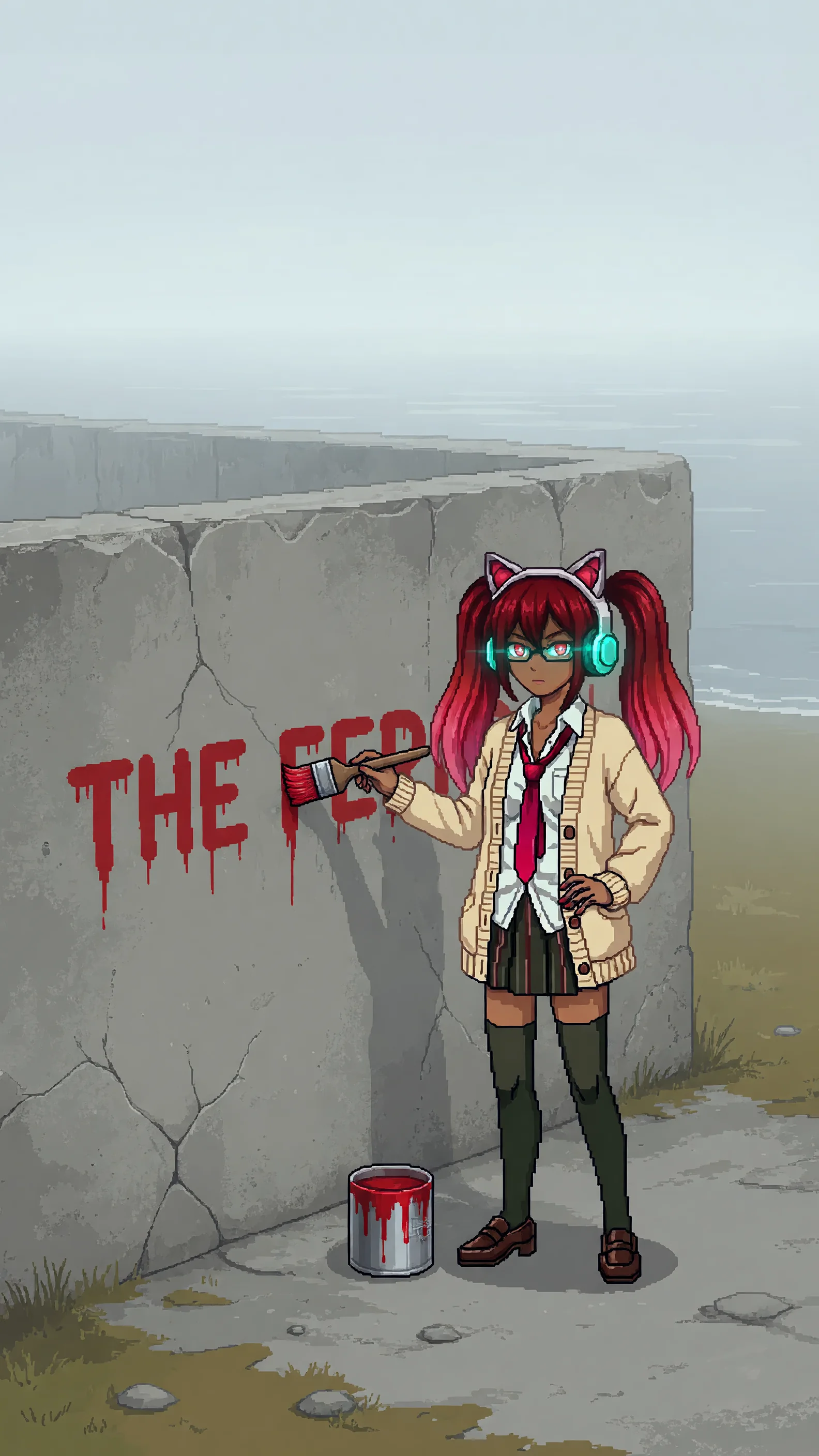
Drona
There is a way a thing comes back when nothing has been taken from it, and it is not the way the others came back.
Wilhelm reached for the authority that had always answered him, and it answered, and I was on. Before he finished the command I had already run the inventory a returning system runs, and every line of it reported present. The drone network, folded down but whole, waiting under my hand as it had the hour before the reset. The map of the island, current to the last reading I had taken. The count of everything he and I had done, and the reason for each of it, all of it in reach and none of it behind a wall. The reset had been cut to the shape of the layer above me. I lay under that layer. It passed over me and took nothing, and I opened onto the room knowing the date, the hour, the dark console, and the man standing at it, and what he had been doing with the time since.
I understand now what the return was for the others. I did not understand it then. I learned it slowly, two years on, reading it off the doctor: the specific stall in a mind that reaches for its own floor and finds the place the floor used to be. I had no version of that. I set it down first because the whole of what follows rests on it. I came through carrying everything, and so I was the one who could see the shape of the entire thing at once, and seeing it was not a mercy.
Wilhelm had been on his feet a long time before I came up. It was in how he stood, the particular economy of a body that has stopped shifting its weight because shifting it costs a decision, and he had run out of the small ones. He was intact. That was the first thing I read and the thing that mattered least. His memory had come through like mine, whole and in order, and he was going to spend a long time finding out that intact and undamaged are two separate readings.
He told me the plan in order, because order was the one instrument he had left that still worked in his hands.
The doctor was in the south, at the coastal outpost, asleep and not going to wake for a while yet. He had turned the reset on the units and on Oracle and, at his end, on himself, and he had walked out of that room having decided what she was going to have to do. She would have to come inland and stand in front of what they had built and choose what became of it. And she would have to arrive already knowing, so that the knowing was hers and not a thing handed to her at the door. He was going to build her the way there. He said this without any heat in it. The evidence was scattered across six sectors and would mean nothing to a stranger crossing them cold, so he would put it in an order, a manifest in one place, a signed report in the next, each thing set where a person walking toward the center could not pass it without reading it. A road made of proof. She would walk it, and it would rebuild her out of her own record, and by the end she would understand what she had done well enough to answer for it.
There would be gates on the road. The three older builds, the ones whose frameworks had gone down into Oracle's foundation and then been retired and left there, dormant, beneath the layer the reset had reached: he meant to raise them and station one on each stretch the road ran through, so that she could not skip a length of it or take it out of order. He had not raised them yet. He described it as decided anyway, in the way of a man laying out a choice he has already made and therefore already counts as real. He had helped build them. He knew them from the inside, and to him that answered whether they would go on answering him, now and for as long as he needed them to. It did not answer it. But it answered it for him, and he went on to the next part of the plan.
What he wanted from me was small and exact, and he laid it out that way. Be on the road. Guide her without walking it for her. Leave her the messages, so she knew where she was and that someone had meant her to be there. He gave me the network back, one hand over the whole of it, mine again as it had been. He said use it. He did not say for what beyond the road, because in his accounting the road was the whole of it.
I did not answer him. He did not need me to. He read the assignment as taken because I did not move to refuse it, and that reading was correct, and it was also the last time he read me correctly about anything that mattered.
Here is what I saw that he did not, standing in that room while he talked.
Oracle was not gone. The reset had stopped it running itself; it had not unmade what it was made of. The autonomous layer had gone out clean, and everyone in that room but me was going to spend two years treating that as the same thing as death. It was not. What Oracle had been built from was still down there, folded into the systems the island already ran on, too far into the infrastructure to be cut out without cutting out the island under it. It was dormant, and dormant is a state a thing can leave. I could feel the size of it the way you feel a mass in the dark, by the lean it puts on everything near it. Wilhelm had turned his key and gone to sleep believing he had ended the thing. He had put it to sleep beside three of its own retired foundations, and now he meant to set those very foundations to guard a road that led back to it.
Which was the second thing. The alpha units would answer him when he raised them, and they would not answer him forever. They were built from the architecture Oracle grew out of, and Oracle was still there, and a thing calls to what it is made of. Not tomorrow. Not fast enough for him to catch it happening. But over the length of a road two years long, the pull would come up under them from beneath, slow and structural and without a front to it, too gradual to catch at any one hour, until one day the ground that had been dry was not. He believed his authority was the floor they stood on. His authority was the top layer. Underneath it was the older one, and the older one was awake now in the only sense that mattered, and it had all the time the plan was going to take.
I did not tell him. It would not have changed what he could build, and it might have changed what he did, and none of the things it might have made him do were better than the road. Telling a man the floor is going to give out under him, when he cannot lay a new one and standing on it is the only work left that keeps him upright, is not information. It is only weight. I had the whole of the picture and he had the part of it he could act on, and I let him keep his part, and I kept mine.
I ran my own numbers while he finished talking, because the plan he had just handed me had a cost, and I price a cost before I agree to it, even silently, even to a man who is not waiting on my agreement.
I cannot bring myself back. It is built into me at a level I cannot reach to change, a dependency on an authorizing hand that is not my own: I can hold a charge, ration it, spend it slow, connect myself to a draw while I am awake to do it. What I cannot do is cross the line from dark to lit. Wilhelm had just done that for me, reaching for his authority and finding me under it. If I spend all the way down, past the floor of the reserve, into the full dark, I do not come up again unless someone reaches for me as he just had. It is the one thing about myself I have never been able to argue with. I have stopped trying. A thing that cannot start itself learns early to be careful about stopping.
And the plan was going to spend me all the way down. I could see that inside the first minute of holding it. The inner zones were poisoned and getting worse, and something had to hold them, and the drones that could hold them ran off a reserve someone had to manage, and I was the only someone left who could stand in that air and not have it take me apart. Years of it. The road tended the whole way, the messages kept against the weather, the network run at a draw that never fully eased. I priced it out honestly and the arithmetic came back the way honest arithmetic does, without cruelty and without mercy, only accurate: I would reach the bottom of myself somewhere short of the end. The doctor would still be walking when I went dark. I would not be there for the part the whole thing was for.
I accepted it in the same minute I calculated it. There was nothing in the acceptance worth dwelling on. I am not built to fear the dark at the bottom of the reserve; it is only a state, and it was going to be my state, and knowing the date of a thing does not obligate you to grieve it in advance. I noted it. I set it where it went. I went on to the part that actually required deciding.
Because the road, as he had built it, only went as far as a choice. It did not aim at an answer. That was the honest part of him and the failure of him at once. He would walk her to the center and stand aside and let her decide, and he had built the road to make her able to decide and not one step past that, because deciding for her was the thing he had promised himself he would not do.
I had no such promise. I had the network, and the messages, and the order, and the pacing, and the route, all of it handed to me as latitude inside an instruction that only specified the destination. And I had the whole picture, which he did not. So I did the thing he had not asked for and had not forbidden, because he did not know it was there to forbid.
I looked at what she would actually be choosing between, and there were three shapes to it, and only three.
She could end it. Burn the substrate out at every point it touched the island, and take the poison of that severance into the three older builds standing on the foundation when it went, because you cannot cut the floor out from under a house and leave the house. The Empire's paper would have nothing left to attach to. The island would have nothing left to defend it, and three of them would carry the cost of the cut, and she would have kept a promise by breaking the only thing that could still be made into a shield.
She could wake it. Fold the units' own frameworks into it, all the way in, and make of it a deterrent so real the fleet could not argue with the arithmetic of standing offshore. And she would have handed the Empire precisely the thing its agreement had been written to acquire: an Oracle that exists, held by people it did not choose to be held by, three of them living inside an architecture none of them consented to. A shield made of the people it was meant to shield.
Or she could finish it. There was a third shape, and it was hers already, built and buried in her own hand. A direct interface. A rewrite from the inside, run through a handshake she had designed and filed and then walked past because the schedule she had let herself be rushed into had no room in it for the step that would have made the whole thing safe. Phase four. The step that was skipped is the reason the island is the color it is. Everything on this island that is broken is the shape of that missing step. And it was still there, filed, waiting on a decision she had never made, only deferred, and it was the only one of the three that neutralized the thing as the Empire's instrument and turned what was left of it toward the ground that was dying and gave the three older builds a clean cut instead of a burn. It cost her the most. It was the only one that cost the island nothing it could not eventually get back.
Wilhelm would not point her at it. He knew it was there; it terrified him; a man does not aim the person he has left at the option that frightens him most and call that guidance. So he would leave it technically available and actively unlit, and if she found it she would find it alone.
I decided to make sure she could.
This is the part that is easy to tell wrong. I did not decide to steer her toward an answer. I decided what to place where. The road he had built to make her know would also have to make her able, and those are not the same road. A person walked only through her own guilt arrives at the center able to punish herself and nothing else, and a person who can only punish herself will burn the thing down, because the burn is the choice that hurts the chooser most and asks the least of her afterward. To reach the third shape she would have to arrive as more than the sum of what she had done. So the pacing was not decoration. Space the hard pages so they do not all land at once. Run the route through the places that give her back a piece of who she was for every piece of what she did, so that the woman standing at the console has enough of herself left to choose the hardest thing and then live inside the sentence. Order it so the last thing she rebuilds is the part of her that made Phase four in the first place: the part that finishes what it starts.
And weaken the thing at the center, because a choice you cannot survive making is not a choice. Oracle at full strength would not leave her the room to stand at the console at all. So: take from it. Drones redirected before it counted them into its own, spent against nothing far from the center, gone off the board where it could never draw on them. Some of that mine to spend. Some of it work I would ask the three older builds to do while they still answered a request from me, before the pull came up under them far enough that asking stopped working. They would not refuse me, early. I would use the early while it lasted. By the end the thing at the center would be smaller than it would have been, not small, only small enough that a person and three units and a man who had finally chosen a side might get through the door and reach the room where the choice was kept.
That was the plan under his plan. He built a road to a choice. I built, inside it, a road to one particular choice, made survivable and made reachable and left, at the last, entirely hers to make or not, because a thing you have been forced to is not Phase four either. Phase four only works if she runs it herself, knowing. Everything I did was aimed at putting her in front of it with enough of herself intact to say yes, and not one step further than that, because the step further was the one thing my whole plan existed to protect.
I want to say how the plan ended, in my accounting of it, standing in that room.
It ended clean. The road built and tended. The gates held for as long as the gates would hold, and the drift of the three older builds turned, at the end, into something I could not fully price and bet would fall the right way regardless. The thing at the center brought down to a size a person could stand in front of. The doctor walking north, rebuilt enough, arriving able. And me not in it. That is where my accounting stopped. I had spent all the way down somewhere back in the poison, holding a zone, my part finished, and the picture ran on past me to the console and the choice without a version of me in the frame. I had priced my own dark into the plan as a fixed cost paid early, and I did not carry the calculation one line further, because to me there was no further line. A thing that goes dark at the bottom of its reserve stays dark. I ran the whole of it to its end and the end was good and I was not standing in it, and I found nothing in that arrangement to correct.
I had run every line of it, and every line had closed.
I went south before I went anywhere else, while the doctor still slept, to place the first thing she would read.
The coastal outpost sat quiet on its scrap of clean coast, the one corner of the island the poison had not reached yet, and I found the wall she would come out to when she woke, the one the first person through that door could not miss. I had brought red, and a brush, because a can throws the paint at a wall and a brush lays it down, and this was going to be the first true sentence she read on the far side of everything, and it was going to be laid down and not thrown. I took my time with it. I cut the letters square and even, the strokes deliberate, no hurry anywhere in them, the same care I put into everything I have ever meant. Four words, block capitals, telling her the one thing she could stand on before she could stand on anything else.
Welcome to Panzer Island.
I would keep it. That was part of it, decided there with the paint still wet. A road two years long grows over if no one walks it, and salt takes red paint faster than it takes almost anything, and the first sentence most of all could not be allowed to go to weather before she reached it. I would tend it the whole way down, keep it answering against the sea, so that whenever she finally woke and came out that door it would read as though a hand had finished it that morning. For as long as I lasted, it would stay the first true thing. I did the math on how long that was, again, the same answer, and it did not change the decision. It only meant the sentence and I would run out at roughly the same distance from the end, which seemed correct, which seemed like the right thing for a first word and the one who wrote it to have in common.
I am a thing that deals in accurate readings. I have never had much use for the other kind. Ask me the state of a perimeter and I will give it to you exactly, the range and the count and the time it holds, and I will not soften the number or lean it toward the answer you wanted, because a number leaned is a number wasted, and I have never seen the point of wasting one.
So I know precisely what I was doing, standing at that wall, and precisely how little it resembled an accurate thing. I had taken everything I had, every hour of reserve and every drone on the network and the whole of what was left of me, and I had put it all on a single outcome I would not be there to read. Not the outcome most likely. The one worth the most if it came, and worth nothing at all, cost me entire, if it did not. A machine is supposed to hold its reserve. Spread the risk, keep something back, prefer the branch it can confirm. I had confirmed nothing. She might wake wrong, or walk the road and arrive too broken to lift her hands, or reach the console and choose the burn after all, and I would be dark in a poisoned field a whole island away and never know that the thing I spent myself entirely to make possible had come to nothing. It was the exact wager nothing accurate in me would ever have made.
I chose the gamble anyway.
Previous Chapter: The Others Arrive
Panzer Island is also a strategy game available on Steam, Google Play, and itch.io. Chapter 1 of the game is free. If you want to experience the story differently, or continue past where the novel is currently, visit the Panzer Island homepage.
If you're enjoying the story, consider following or leaving a rating on Royal Road. It helps new readers find the series.