Chapter 30: Dormant
Published August 13, 2026
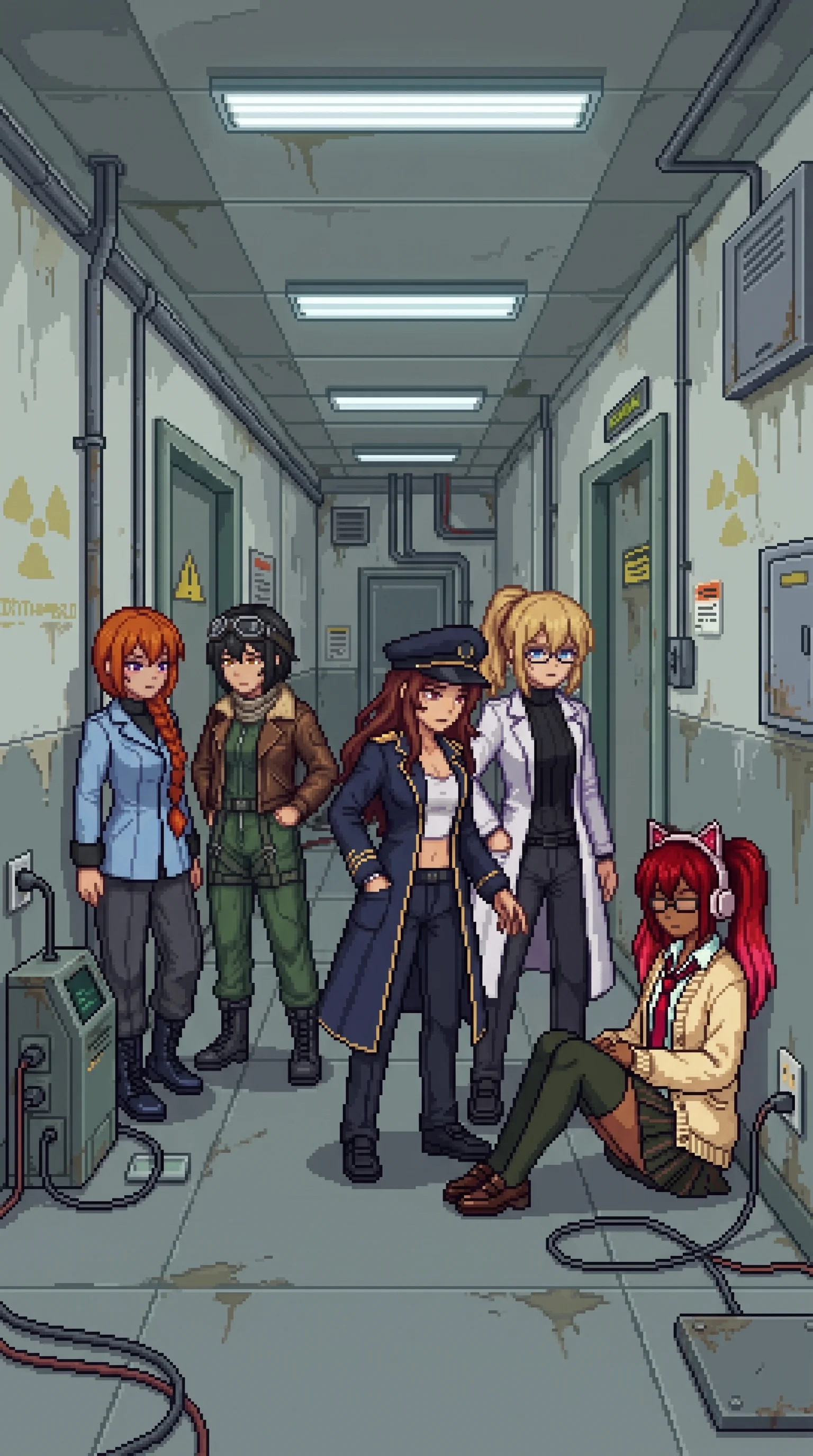
The service gallery ran downward, not stairs but a grade, the floor tipping under us a degree at a time, until the archive light was gone, leaving only the strip lighting that held this deep, spaced too far apart, the middle of every corridor a grey the exact color of the walls.
This was the bottom of the sector. The rooms stopped opening inward and began opening out: storage chambers the size of hangars, sealed behind doors rated for something worse than fire, and past the seals the line itself: vats, coupled piping, the corroded skeleton of an industrial-scale process. None of it was concealed. It had never had to be. The sector was the concealment, and we were under it.
I did not remember choosing the turns. I had stopped noting that a sector back.
We heard the fight before we reached it.
It came up the gallery ahead of us, the arrhythmia of weapons fire without cadence, and when the last chamber opened onto the storage floor I understood the sound. The drones down here were not the drones we had been clearing all week. Those had held a picket, fired on a line, moved to a doctrine I could watch Katyusha read. These had none. They had been in the inner zone since the catastrophe, and the years in it had taken the tactics out of them and left the reflexes, so that they fired when a thing crossed a threshold and not when firing served them, wheeled into walls, spent themselves against nothing. There was no pattern to take cover from, only the volume.
And there was Drona.
She was in the middle of the floor, fighting. Not near us, not with us, simply in it, on the same side only by what she was shooting at. Her movements had a worn quality, the paths of something that had cleared this room more times than it could have wanted to, nothing decided because everything had been decided long ago. Both her headphone earpieces burned a flat, full red, not the flicker from the array or the steady orange from the gallery this afternoon: red all the way through, the color of a reserve spent at the rate that empties it.
Katyusha put her tank between the team and the worst of the fire, and I put myself behind it, low, against the tread housing. From there I could see all of it and touch none of it, which had been my position on this island since the first morning.
Nadeshiko
I could not read them.
That was the whole of it, the thing I kept arriving back at. I read things. It is the one function of mine that never had to be recovered, because it was never taken. Give me an approach and I will tell you where the next shot comes from before it comes. These gave me nothing to tell: they did not intend, and a thing that does not intend cannot be anticipated, so I flew the way you fly in cloud, on instruments and nerve, hitting what was in front of the barrel and trusting the others for the rest.
Drona I could not read either, and that was different, and worse. She was on my flank for one exchange, close enough to fly wing to, and I reached for her the way I reach for anyone beside me, to find the shape of what she would do next. There was no shape. She was not hiding one. She was running lines older than choosing, worn past the point where a next move is a move at all. I had the certain sense that I had done this before, flown alongside something that could not answer me back. I put the query for it the way I put every query, and braced for the small drag of a search running down through everything I hold. It came back with no drag at all, no candidates. A search returns that fast only when there is nothing there to search, and the speed of the emptiness was the whole of the answer.
I let it go and took the shot in front of me. There is always a shot in front of you. That much I have never lost.
Erika
It ended the way those things end, not with a last stand but with a last drone throwing itself against the floor and none after it. The volume dropped out of the room and left the size of the place ringing in it.
Drona stood among the wreckage she had made alongside us and did not so much power her weapons down as let them go quiet. Up close the compensation in her movement had worsened through the fight; there was a hitch between intention and motion, a half-beat of arithmetic where a body should simply have moved. She stood in it and let it show, which she had not done once at the gatehouse or the array; she had no margin left to hide it.
She spoke, and she spoke more than she had in the whole of the sector.
"He told us to protect this place. From discovery." She did not look for Wilhelm as she said it, because he was not there; she said it to the room, or to the wreckage, or to me. "I have been here a long time." The red in the earpieces did not ease. "The chemicals do not act on me the way they act on the living. I can hold the inner zone for as long as I am asked to hold it." She turned her head, the half-beat catching, and looked at me directly. "You designed us to function here. You knew systems like me would stand in this place."
There was a version of that question that might have let me share the weight out. Whose hand had drawn which line of her, mine or Wilhelm's, behind the gap where none of it would answer anyway. I did not reach for it. She had not asked whose hand. She had asked about the design, and the design was the one thing I had never been able to disown.
"I moved through the inner zone the same way you did," I told her. "My feet did not hesitate. I knew the tolerances before I read a placard for them." The floor was quiet enough that there was nothing to say it into except the truth. "I built you to be able to walk through this. And I built myself the same way, so that I could walk through what I built you for."
She took it without visible change. Answering had not been the point. She had set the fact down where I would have to stand next to it, and she was precise enough to know the difference between that and an accusation.
Her eyes flickered.
It was not an expression. It was a system finding the end of something and routing around it, a half-second of light going sideways behind her glasses before it steadied. She went on through it without a break, the way you keep walking through a stumble so that it does not become a fall.
"Oracle is still here," she said. "It is not gone. The reset stopped it running itself. It did not erase what it was made of. It has been dormant in the island's infrastructure since the night of the reset, folded down into the systems the island already ran on, too far in to burn out of them without burning everything else with it." Her voice stayed level. She had carried this a long time, and it had stopped being heavy; it had only stayed large. "He did not tell you that."
She let a beat pass.
"Did he."
It was not shaped as a question, and I did not answer it as one, because the answer was already in the room and had been since Wilhelm's voice came through the array telling me to remember a thing rather than be told it. He had walked us the length of a poisoned coast toward a machine he had let us believe was ash, and the not-telling was the same instrument as everything else he had built for me: a fact set out of reach, so that I would have to close my own hand on it.
"No," I said. "He did not."
Something in Drona settled at that, a load coming off a strut that had been holding it.
"I have been waiting," she said, "for someone who could come and decide."
Then she stopped.
Not fell. Not failed. The light went out of the earpieces the way a held note ends when the breath is gone, and the half-beat of arithmetic that had caught in her all through the fight caught one final time and did not resolve, and she settled where she stood, upright, into the wreckage, with the stillness of something that has finished the one thing it stayed intact to do. She did not say she would resume. She did not say she had reached her limit. She handed us nothing to carry. She had been managing a reserve for years the way you manage a wound you have decided not to mention, and she reached the bottom of it in the middle of a sentence whose important part she had already spoken, and she let herself go dark.
Maria moved first. She took a step toward the place where Drona had stopped, and said nothing. Maria not saying anything was a position.
"We can't just leave her." Nadeshiko was a half-step past having decided it, the way she gets when the thing to do is plain to her before it is arguable to anyone else.
The cold version was ready in my mouth: that there was nothing to be done at Drona's side that would not have been done for us instead, that spent was not the same as broken and neither was a thing you mended by standing over it. I did not say it. Katyusha had gone to the practical, the weight of her, the grade back up, the nearest live circuit, and I found I did not want to be the one who turned out to be right. I let myself be outvoted by a team that had not taken a vote.
We took her to the charging point she had made for herself.
It was back up in the administrative section, a power draw jury-rigged off a half-live circuit, the kind of arrangement a thing makes to keep managing a failing reserve. She had built herself somewhere to stop. We carried her to it and connected her, and nothing came of it. No light returned to the earpieces. No draw registered. She sat where we set her, upright, dark.
We stayed.
We put our own units on the working sockets while we waited and brought them up to full. The fight had drawn something out of them, but not a full charge's worth. Nobody said what the topping-off was for. It was in the waiting that the rest of it came, the way it comes once you have stopped moving and cannot stop thinking.
Katyusha spoke the largest fact first. "Oracle is dormant in the island's infrastructure. Not gone." She was not reporting it to us; she was fitting it against everything it touched, which for her was a long list. "Wilhelm knows this. He has known it the whole time."
Maria was watching the dark earpieces and not us. "And the Empire. Their instrument." She turned it over as she said it. "Reiss didn't sign away a weapon that fires. He signed away a thing that exists. It doesn't have to wake for the agreement to bite. It only has to be here." She liked it no better out loud. "And it's here."
"Then the window is not the one we believed we had," Katyusha said. "We have been walking toward a decision we thought we would find already made for us. Destroyed, or standing. It is neither. It is waiting. And the people who want it are counting the same days we are."
"So none of it is over." Nadeshiko said it without heat, which was how I knew it had gone in. "It was never over."
"No," I said. "It was waiting for someone who could decide."
Our units came up to full, and Drona did not move. The light did not return to her. Whatever was still running in her ran somewhere I could not reach: the floor she had cleared stayed cleared, her signal did not fall off the edge, the perimeter held. She had not gone anywhere. She was only past reaching, the way the thing at the center of the island was past reaching, present and waiting on the same person to come and do the one thing it could not do for itself.
When the last unit read full, there was nothing left to do at the sockets. So we left her connected, dark, on the rig she had built, and we went.
"Move toward the center," I said, on the way out. "We are not ready yet."
She had told me the machine at the center was still alive as though she were handing me good news. She had waited years in the poison to say it, and had spent the last of herself doing so, like it was a relief.
That was what I carried up out of the dark. Not that Oracle was still alive. That someone had been glad to tell me so.
Previous Chapter: The Second Doctor
Panzer Island is also a strategy game available on Steam, Google Play, and itch.io. Chapter 1 of the game is free. If you want to experience the story differently, or continue past where the novel is currently, visit the Panzer Island homepage.
If you're enjoying the story, consider following or leaving a rating on Royal Road. It helps new readers find the series.